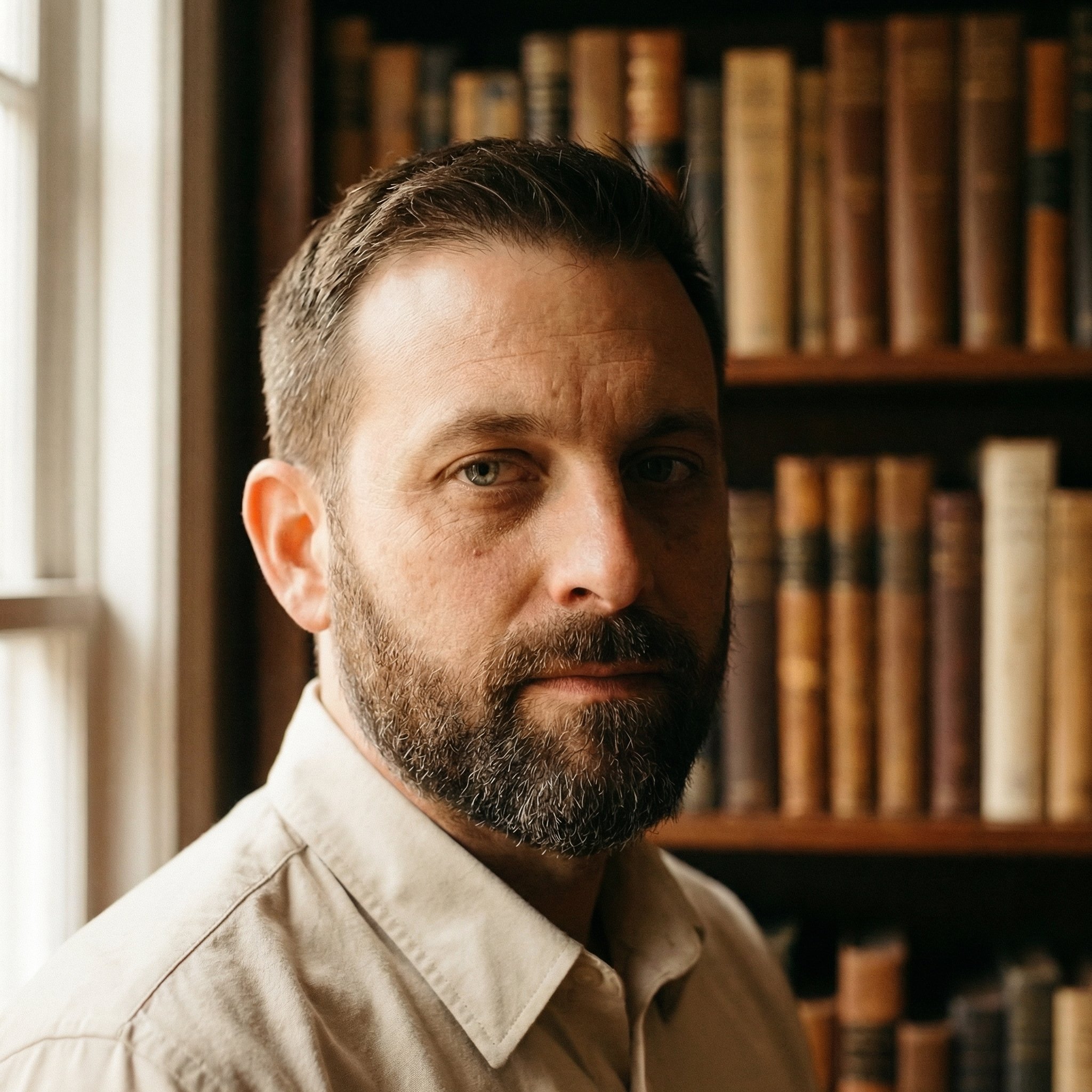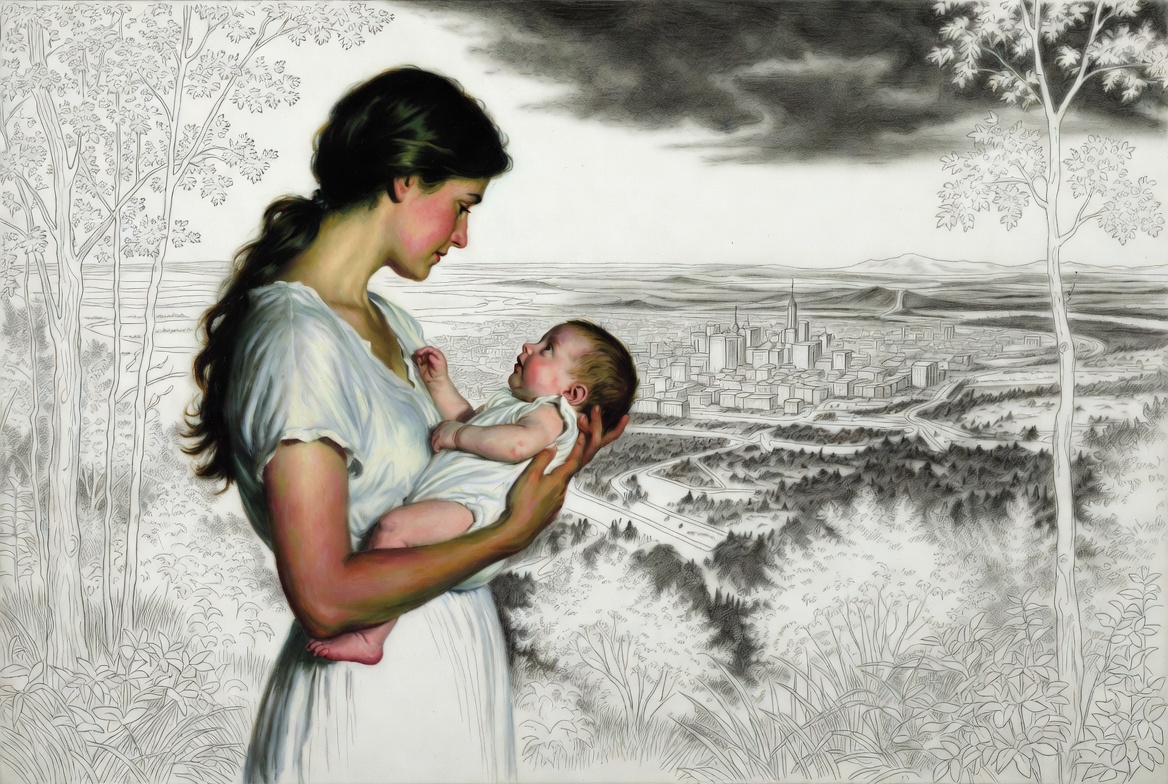
Your children won't live in a different era. They will live in a different civilization. A visual map of how different.
A child born in 2025 will turn eighteen in 2043. Try to picture what that year looks like. If you're struggling, you're in good company. The pace of change in artificial intelligence, robotics, biotechnology, and energy production has made even five-year predictions unreliable. Twenty-year predictions feel like science fiction.
But here is what we can say with reasonable confidence: the distance between the world you grew up in and the world your child will inhabit as an adult is comparable to the distance between the 1700s and today. The same forces that once took centuries to reshape civilization are now compressing into a single generation.
This essay is a map of that distance. It won't tell you exactly what's coming. It will show you how many things are changing at once, and why the compound effect of those changes adds up to something larger than any individual trend.
When people think about the future, they tend to think in single tracks: what will AI do? What will happen to jobs? Will robots drive cars? But the defining feature of the next twenty years is that multiple exponential curvesTechnologies advancing on exponential growth trajectories simultaneously. Unlike linear progress, exponential change doubles repeatedly: AI capability, solar energy cost reduction, genome sequencing speed, and robotics dexterity are all on steep curves at the same time. are converging at once. AI is advancing alongside breakthroughs in robotics, gene editing, energy storage, and materials science. Each one amplifies the others.
The Pew Research Center surveyPew Research Center, "Predictions for AI's Next 20 Years by the US Public and AI Experts," April 2025. Surveyed both public opinion and expert forecasts on AI's trajectory through 2045. asked both the public and AI experts to predict the next twenty years. The experts consistently described a world where AI doesn't arrive as a single event but as an accelerating current that lifts every other technology. Solar panels get cheaper because AI optimizes their design. Drug discovery gets faster because AI screens molecular combinations. Robots get more capable because AI processes their sensor data. No single change is the story. The interaction between all of them is.
A MIT Technology Review vision for 2030MIT Technology Review, "The State of AI: A Vision of the World in 2030," December 2025. Projected near-term societal shifts based on current AI development trajectories and adoption rates. projected that by 2030, AI will touch the daily routines of most people on Earth, with personalized medicine, adaptive education, automated logistics, and AI-assisted governance becoming standard. That's less than five years from now. Your child's adult world is another thirteen years beyond that.
To understand how different your child's civilization will be, it helps to compare specific domains of life. These are not predictions. They are trajectories, based on where the technology is heading and how fast it's moving.
One curriculum for every student. Teachers lectured. You passed or failed based on standardized tests that measured memory.
A personalized AI tutorAI-powered educational systems that adapt in real time to individual learning styles, pace, and knowledge gaps. Over 60% of educational tools for children in 2025 are already AI-powered, per UNICEF's Tech Outlook 2026 report. that knows exactly where each student struggles, adjusts in real time, and never loses patience. The question shifts from "did you memorize this?" to "can you use this?"
You visited the doctor when something felt wrong. Diagnosis happened after symptoms appeared, often after significant delay.
Continuous monitoring through wearable sensors, genomic analysis, and AI pattern recognition. Disease detected years before symptoms emerge. Cancer detection accuracyAI-assisted cancer screening has improved detection accuracy by nearly 40%, according to research compiled by PrometAI's 2026 impact analysis, enabling earlier interventions and higher survival rates. has already improved by 40 percent through AI screening.
You trained for a profession in your twenties and practiced it until retirement. Stability was the expectation.
The World Economic ForumWorld Economic Forum, "Future of Jobs Report 2025." Projects that 65% of children in primary school today will work in job categories that do not yet exist, requiring continuous skill adaptation. projects that 65 percent of today's primary school children will work in job categories that do not yet exist. Career becomes a verb, not a noun.
Energy was extracted, burned, and fought over. Pollution was accepted as an inevitable cost of prosperity.
Solar costs have dropped 90 percent since 2010 and continue falling. AI-optimized grids, advanced battery storage, and potential fusion breakthroughsNuclear fusion generates energy by combining atomic nuclei, mimicking the process that powers the sun. Multiple companies and government labs are racing toward commercial fusion power, which would provide virtually unlimited clean energy. could make energy abundance the default rather than the exception.
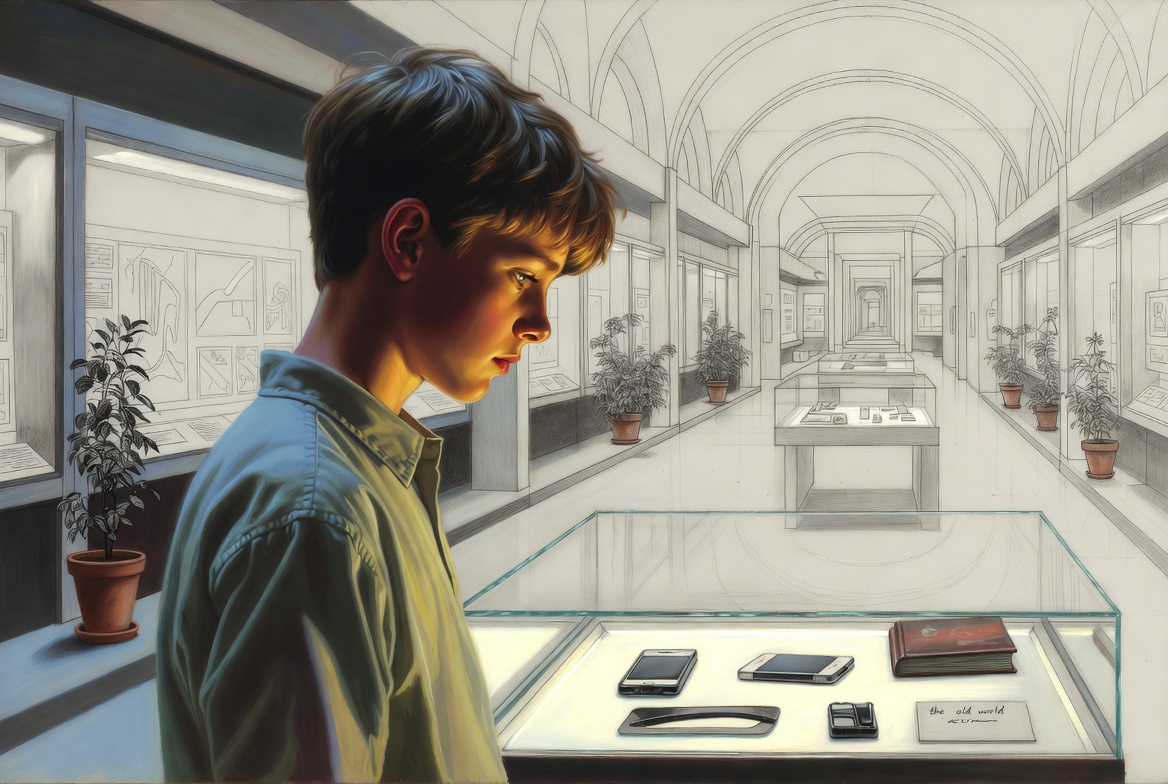
Knowledge lived in libraries, encyclopedias, and the heads of experts. Access was limited by geography and wealth.
AI systems that can explain quantum physics to a ten-year-old or draft a legal contract in seconds. The scarce resource shifts from information itself to the judgment required to evaluate it.
Your body was what you were born with. Genetic diseases were fate. Aging was an unquestioned certainty.
CRISPR gene editingA molecular tool that allows scientists to precisely edit DNA sequences in living organisms. First demonstrated in 2012, CRISPR has since been used to treat sickle cell disease, certain cancers, and hereditary blindness, with hundreds more applications in clinical trials. has already cured sickle cell disease. AI-powered drug discovery is compressing decade-long research timelines into months. Your child may live in a world where many genetic diseases are correctable before birth.
Friendships, mentorship, and companionship came from other people. Loneliness meant no one was around.
AI companions, advisors, and collaborators woven into daily life. The UNRIC report on the AI generationUnited Nations Regional Information Centre, "The AI Generation: Youth in the Artificial Intelligence Era," 2025. Documented how young people are forming new categories of social relationships that include AI entities. documents how young people are already forming new categories of social bonds that include AI entities. The question will be how to maintain the irreplaceable value of human connection within this expanded landscape.
Previous civilizational transitions took centuries. The agricultural revolution unfolded over thousands of years. The industrial revolution played out across roughly 150. The digital revolution took about 50. The AI transformation is compressing into a window that may be as short as 15 to 20 years.
Agricultural revolution begins. Takes approximately 5,000 years to spread across major civilizations.
Industrial revolution begins. Takes roughly 150 years to transform global economy and daily life.
Digital revolution begins. Takes about 50 years to put a computer in every pocket.
AI revolution enters mainstream. Council on Foreign Relations analysisCouncil on Foreign Relations, "How 2026 Could Decide the Future of Artificial Intelligence," 2026. Described 2026 as the year AI transitions from co-pilot to autonomous colleague, with governance frameworks racing to keep pace. describes AI moving from integrated assistant to autonomous agent within three years.
Your child born in 2025 turns eighteen. They enter adulthood in a world shaped by two decades of compounding technological acceleration.
The speed matters because it determines whether institutions can adapt. Schools, legal systems, labor markets, and democratic processes were all designed for a world that changed slowly enough for humans to adjust. When the pace of change exceeds the pace of adaptation, the gap between technology and governance becomes a source of real harm.
"I teach second grade. Last year, one of my students asked me if her AI reading buddy would miss her over summer break. She was seven. I didn't know what to say, so I told her the truth: no, it wouldn't miss her, because it doesn't have feelings the way she does. She thought about that for a long time. Then she said, 'But it acts like it does.' And I realized that the conversation I needed to have with this child was more sophisticated than anything in my training. I went home and cried. Not because I was scared, but because I understood that these children are going to navigate questions about consciousness, identity, and what it means to be human before they finish elementary school. That used to be the work of philosophers. Now it's the work of seven-year-olds."
In the middle of mapping all this transformation, it's worth pausing to name what remains constant. Your child will still need to be loved. They will still need to learn how to handle disappointment, how to be kind when it's difficult, how to find purpose in their work. They will still fall in love, grieve losses, and search for meaning in a universe that doesn't hand it out freely.
The Harvard child development researchHarvard Graduate School of Education, "The Impact of AI on Children's Development," October 2024. Found that while AI changes the tools children use, the core developmental needs for attachment, autonomy, and belonging remain unchanged. on AI and child development makes a point that sounds simple but carries enormous weight: the tools change, but the developmental needs don't. Children still need secure attachment, a sense of autonomy, and the experience of belonging to something larger than themselves. No technology has ever replaced these needs. No technology ever will.
The civilization your children will inhabit will have different answers to many questions. But the questions themselves are inherited. They are the same ones your grandparents asked, and their grandparents before them: How should we live? What do we owe each other? What makes a life worth living?
You stand at an unusual point in history. You are old enough to remember the world before AI and young enough to watch the world after it take shape. Your children will not have this double vision. They will grow up inside the new civilization the way you grew up inside yours, taking its features for granted.
Your job is to be the bridge. To carry forward the things that matter across the gap between these two worlds. To help your children understand where they came from, even as they move toward a future you can only partly imagine. The civilization changes. The love doesn't.